Next-Generation Computing Architecture: Making Supercomputers Faster, Simpler, and More Reliable
## 1. What Is the Core Problem with Today's Servers?
Today, the entire cloud computing and artificial intelligence industry is built on rules invented 30 years ago. A standard server rack is a bulky shelf of metal boxes connected by kilometers of copper wires and complex central switches.
This architecture has reached its physical limits for three reasons:
- **Copper wires can no longer keep up with speed.** At modern frequencies, electrical signals in copper attenuate and distort after just 15–20 centimeters. To get a signal from a processor to a network card, engineers must install chains of special amplifier chips that generate enormous waste heat.
- **The server memory paradox.** To install a terabyte of RAM in a single server, manufacturers must add buffer chips to memory modules. These extra chips make server memory slower than memory in a compact desktop computer, which uses short traces connected directly to the processor and responds 30–40% faster.
- **Massive software overhead.** A standard server Linux takes a minute to boot, contains millions of lines of legacy code, and spends a third of CPU resources simply shuffling data between internal buffers.
We designed a computing system from scratch, eliminating all these bottlenecks.
## 2. Form Matters: Why Our Server Is Round (Torus)
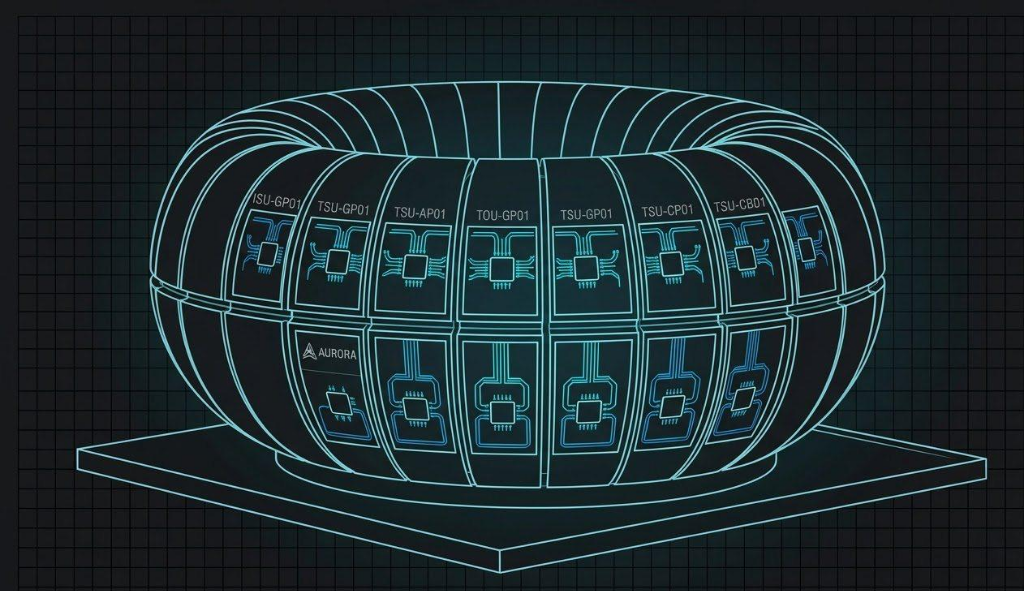
Instead of a flat rectangular rack, our system takes the shape of a monolithic ring — a torus. The physics behind this shape is rigorous:
- **Shortest data path.** In a standard rack, a signal from the top server to the bottom travels through 2–3 meters of cables and a central switch. In a closed ring, the distance between any two blocks is minimal: all compute nodes are within arm's reach of one another along the perimeter.
- **Light instead of copper (Optics).** Inside the ring, data travels as light pulses through optical micro-channels. Light doesn't heat the board, is immune to electromagnetic interference, and transmits data orders of magnitude faster.
- **Chimney-effect cooling.** Conventional server rooms require complex air conditioning with separated hot and cold aisles. The circular enclosure draws cool air from the outside across the full 360-degree perimeter, cools the chips, and exhausts heated air upward through a central chimney duct using natural convection and a low-speed central fan.
## 3. Modularity: A Supercomputer as a Construction Kit
The entire system comprises transparent module-segments inserted around the ring:
- **Task-specific modules:** A module with general-purpose CPUs (for general computing), a module with neural accelerators (for AI workloads), and a module with ultra-fast storage (for databases).
- **U-shaped optical connector:** Each module connects to the shared ring via a clamp that wraps around the circular optical bus from both sides.
- **Toolless hot-swap:** The connector uses micro-lenses that expand the light beam. Optical contact is immune to dust and micro-vibrations, and magnetic guides self-center the module with precision.
## 4. Direct Interconnect: Why We Eliminated Network Switches
We replaced the central switch with a direct ring interconnect using **Zero-Copy DMA**:
- A processor in one node can instantly place data directly into a neighbor's RAM, bypassing network protocols, the OS, and intermediate buffers.
- Inter-node latency drops from 25–30 μs to **1.5–2 μs** — on par with the world's most expensive specialized supercomputers.
- **Sub-millisecond self-healing:** If a node physically disconnects, neighboring machines instantly reroute the data stream in reverse along a secondary contour.
## 5. Custom Operating System: ALLIUM HCOS
We built a specialized system, **ALLIUM HCOS**, based on three core principles:
- **Immutability (Frozen System).** The OS image is write-protected. No power failure, user error, or malware can corrupt it.
- **Instant boot in 0.05 seconds.** We stripped the kernel to essentials and wrote a custom micro-bootloader in Rust. The system starts in 50 ms — 1,000× faster than standard Linux.
- **Zero-Touch provisioning.** Modules are plugged in, discover each other over optics within 3–5 seconds, and automatically form a unified cluster.
## 6. A New Approach to Databases
We separated compute from storage:
- The processor handling user queries doesn't keep a database on its local disk.
- All changes instantly propagate via the optical bus to the RAM of **three neighboring machines** — hundreds of times faster than writing to the most expensive SSD.
- Data loss is physically impossible: even if the primary node burns out, its latest operations are already replicated in neighbors' memory.
## 7. Intelligent Capacity Management
- **Unified AI memory pool.** All modules in the ring combine their GPU memory into one giant pool, enabling large neural networks to run without requiring scarce, monopoly-priced accelerator cards.
- **Scale-to-Zero with instant wake-up.** When a service receives no requests, its module sleeps and consumes near-zero power. On the first incoming request, it wakes in just 0.08 seconds.
---
**Key takeaway:** This project is a ground-up rethinking of supercomputer architecture — toroidal geometry, silicon photonics, direct processor-to-memory interconnect, and a specialized Rust-based OS that boots in milliseconds. The result: the computing power of an entire server room packed into a compact, reliable, and energy-efficient monolith that scales by simply slotting modules into the ring.