Insights & Publications — Bigler Capital
Analytical articles, manifestos, and research by Bigler Capital on systems architecture, decentralized networks, PWAs, AI infrastructure, and next-generation energy storage.
Next-Generation Computing Architecture: Making Supercomputers Faster, Simpler, and More Reliable
1. What Is the Core Problem with Today's Servers?
Today, the entire cloud computing and artificial intelligence industry is built on rules invented 30 years ago. A standard server rack is a bulky shelf of metal boxes connected by kilometers of copper wires and complex central switches.
This architecture has reached its physical limits for three reasons:
- Copper wires can no longer keep up with speed. At modern frequencies, electrical signals in copper attenuate and distort after just 15–20 centimeters. To get a signal from a processor to a network card, engineers must install chains of special amplifier chips that generate enormous waste heat.
- The server memory paradox. To install a terabyte of RAM in a single server, manufacturers must add buffer chips to memory modules. These extra chips make server memory slower than memory in a compact desktop computer, which uses short traces connected directly to the processor and responds 30–40% faster.
- Massive software overhead. A standard server Linux takes a minute to boot, contains millions of lines of legacy code, and spends a third of CPU resources simply shuffling data between internal buffers.
We designed a computing system from scratch, eliminating all these bottlenecks.
2. Form Matters: Why Our Server Is Round (Torus)
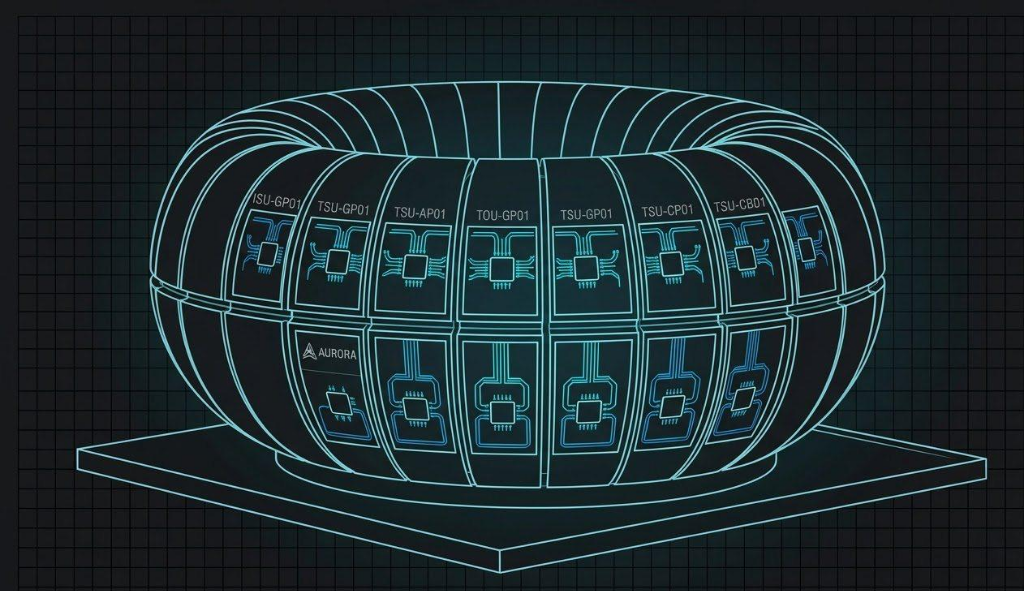
Instead of a flat rectangular rack, our system takes the shape of a monolithic ring — a torus. The physics behind this shape is rigorous:
- Shortest data path. In a standard rack, a signal from the top server to the bottom travels through 2–3 meters of cables and a central switch. In a closed ring, the distance between any two blocks is minimal: all compute nodes are within arm's reach of one another along the perimeter.
- Light instead of copper (Optics). Inside the ring, data travels as light pulses through optical micro-channels. Light doesn't heat the board, is immune to electromagnetic interference, and transmits data orders of magnitude faster.
- Chimney-effect cooling. Conventional server rooms require complex air conditioning with separated hot and cold aisles. The circular enclosure draws cool air from the outside across the full 360-degree perimeter, cools the chips, and exhausts heated air upward through a central chimney duct using natural convection and a low-speed central fan.
3. Modularity: A Supercomputer as a Construction Kit
The entire system comprises transparent module-segments inserted around the ring:
- Task-specific modules: A module with general-purpose CPUs (for general computing), a module with neural accelerators (for AI workloads), and a module with ultra-fast storage (for databases).
- U-shaped optical connector: Each module connects to the shared ring via a clamp that wraps around the circular optical bus from both sides.
- Toolless hot-swap: The connector uses micro-lenses that expand the light beam. Optical contact is immune to dust and micro-vibrations, and magnetic guides self-center the module with precision.
4. Direct Interconnect: Why We Eliminated Network Switches
We replaced the central switch with a direct ring interconnect using Zero-Copy DMA:
- A processor in one node can instantly place data directly into a neighbor's RAM, bypassing network protocols, the OS, and intermediate buffers.
- Inter-node latency drops from 25–30 μs to 1.5–2 μs — on par with the world's most expensive specialized supercomputers.
- Sub-millisecond self-healing: If a node physically disconnects, neighboring machines instantly reroute the data stream in reverse along a secondary contour.
5. Custom Operating System: ALLIUM HCOS
We are developing a specialized system, ALLIUM HCOS, based on three core principles:
- Immutability (Frozen System). The OS image is write-protected. No power failure, user error, or malware can corrupt it.
- Instant boot in 0.05 seconds. We stripped the kernel to essentials and wrote a custom micro-bootloader in Rust. The system starts in 50 ms — 1,000× faster than standard Linux.
- Zero-Touch provisioning. Modules are plugged in, discover each other over optics within 3–5 seconds, and automatically form a unified cluster.
6. A New Approach to Databases
We separated compute from storage:
- The processor handling user queries doesn't keep a database on its local disk.
- All changes instantly propagate via the optical bus to the RAM of three neighboring machines — hundreds of times faster than writing to the most expensive SSD.
- Data loss is physically impossible: even if the primary node burns out, its latest operations are already replicated in neighbors' memory.
7. Intelligent Capacity Management
- Unified AI memory pool. All modules in the ring combine their GPU memory into one giant pool, enabling large neural networks to run without requiring scarce, monopoly-priced accelerator cards.
- Scale-to-Zero with instant wake-up. When a service receives no requests, its module sleeps and consumes near-zero power. On the first incoming request, it wakes in just 0.08 seconds.
Key takeaway: This project is a ground-up rethinking of supercomputer architecture — toroidal geometry, silicon photonics, direct processor-to-memory interconnect, and a specialized Rust-based OS that boots in milliseconds. The result: the computing power of an entire server room packed into a compact, reliable, and energy-efficient monolith that scales by simply slotting modules into the ring.
Alatau Valley: The World's First Green Extraterritorial Digital Valley
Author: Arthur Bigler (Chief Visionary Officer, Bigler Capital)
Document Status: Public Concept (Executive Summary)
Global Challenge and Window of Opportunity
The global tech market has entered a stage of total geopolitical division. In the era of explosive growth of Artificial Intelligence and Web3, multinational corporations are facing an unprecedented crisis of jurisdictions. The West is stifling innovation with over-regulation (AI Act) and legalizing intelligence agency access to data (CLOUD Act). The East is building impenetrable sovereign firewalls. Traditional havens (Dubai, Singapore) are overheated, and their tropical climate makes cooling giant data centers ecologically dirty and unprofitable.
Global capital and BigTech corporations critically lack "neutral waters" — a physically and legally secure territory with green energy.
Kazakhstan, possessing a unique geographical arbitrage between two superpowers, political neutrality, and ideal terrain, has a historic chance to occupy this niche. Bigler Capital presents the Alatau Valley concept — the world's first Zero-Carbon extraterritorial digital valley integrated into the foothills of the Trans-Ili Alatau.
Project Architecture: 4 Pillars of Technological Superiority
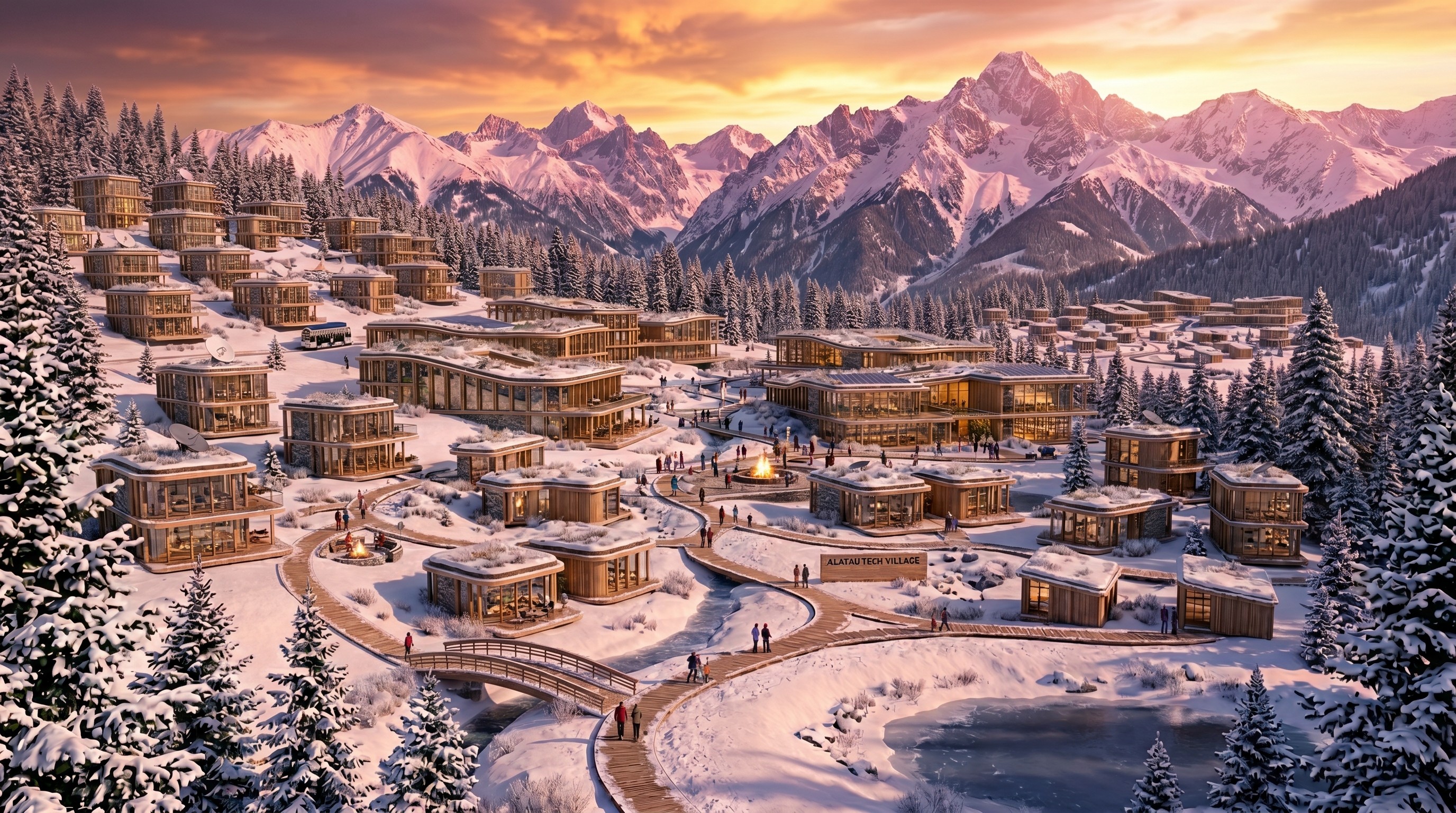
The Alatau Valley project is not a classic technology park with glass skyscrapers in a bare steppe. It is a sovereign Live-Work-Play class ecosystem built on the foundation of absolute safety and autonomy.
1. "Absolute Protection" Engineering (Brownfield Development)
Alatau Valley uses the mountains not just as a beautiful backdrop, but as an engineering shield. The project involves renovating abandoned Soviet rock bunkers in the mountains of Almaty into hyperscale TIER-IV data centers. Meters of granite massif guarantee the highest degree of seismic protection and physical security for servers, creating the ideal digital sanctuary for crypto assets and AI laboratories.

2. Energy Island and 100% ESG (Zero-Carbon)
Energy is the main currency of the AI era. Alatau Valley solves the power deficit of the southern region through the creation of a fully isolated micro-hydro system.
- Own Generation: Cluster power is provided by eco-friendly run-of-river mini-hydro plants on mountain rivers and a gravity battery system (Island Mode).
- The Holy Grail of ESG: Icy mountain air provides free natural cooling (Free Cooling). This makes the Valley the world's first IT hub with a verified zero carbon footprint, opening the floodgates for trillions of Western ESG funds.

3. Institutional Protection and Free Technological Zone
World-class infrastructure requires corresponding guarantees for investment and intellectual property protection that are understandable to multinational capital.
- Special Legal Regime (Scaling the AIFC Model): Drawing on the successful national experience of the Astana International Financial Centre, the principles of English common law and the international concept of "Data Jurisdiction" are implemented in the Valley.
- Digital Asset Protection: Any compliance control procedures, IT audits, or requests for physical and digital access to residents' server infrastructure are strictly regulated by international commercial standards. Such procedures are possible exclusively within the legal field of the independent International Arbitration of the Valley. This forms an absolutely transparent environment, excluding non-market risks and protecting IT businesses from unauthorized interference.
- Customs Fast-Track: The Valley receives the status of a Free Customs Zone. Servers and GPU chips are imported through a logistics green corridor from the Khorgos dry port without duties or VAT. Cheap Asian hardware meets expensive Western software on neutral ground.

4. Talent Urbanism and the "Comfort Trap"
To attract and permanently retain global IT geniuses, the Valley is built on the principle of an elite mountain eco-resort.
- Skyscraper Ban: A strict Zero-Skyscraper Policy.
- Transport Revolution: Silent Swiss cable cars (gondolas) instead of highways, and the extension of the "Aeroexpress" railway line directly from Almaty International Airport.
- Eco-Heating: Excess heat generated by servers in the rocks during neural network training is used for free eco-heating of residential buildings (barnhouses) and SPA complexes.
Macroeconomic Impact for Kazakhstan (ROI)
Alatau Valley is an asymmetric response to reliance on raw commodity exports. With Zero CAPEX from the state budget (infrastructure is paid for by foreign sovereign wealth funds), the project generates historic metrics:
- Foreign Direct Investment (FDI): Absorption of $5 billion to $8 billion in the first 5 years.
- GDP Growth: An additional $3-5 billion annually from transit and export of computing power.
- Job Market: Creation of up to 100,000 new jobs in IT, construction, and elite services.
- Reversing "Brain Drain": Kazakhstan becomes the ultimate point of attraction for global talent, securing its geopolitical inviolability.
From the Concept Author (Visionary Note)
"In developing this concept at Bigler Capital, I relied not only on the vision of an international systems architect, but also on my roots. My blood is half Kazakh. Today, the country has colossal ambitions to build a strong state (New Kazakhstan), but visionary projects of a global scale are needed for a historic breakthrough. My goal is to transfer my engineering experience to my historical homeland, acting as the systems integrator of the Alatau Valley project to ensure a firm bridge of trust between the state, capital, and global BigTech corporations."
CLASSIFIED INFORMATION FOR INVESTORS AND GOVERNMENT SECTOR
This memorandum is the conceptual facade of the project (Executive Summary).
Currently, Bigler Capital is initiating the formation of a closed Investment Consortium to bring the project to the government level and present it to sovereign wealth funds.
The detailed architectural and financial Master Plan (White Paper), including:
- Engineering diagrams of the micro-grid energy autonomy (island-mode) and data center PUE calculations;
- Management Company monetization business model;
- Draft legal framework for extraterritoriality;
- Project deployment roadmap;
The project is a commercial secret and is provided exclusively upon closed request to representatives of the public sector and strategic partners after signing an NDA.
Project details can be requested via official inquiry to: ceo@bigler.capital
Expanding Horizons: Bigler Capital Announces Search for Strategic Partnerships and Residency
Expanding Horizons: Bigler Capital Announces Search for Strategic Partnerships and Residency
As the global financial and technological landscapes continue to evolve, Bigler Capital is actively positioning itself for the next phase of its international expansion. Today, we are proud to announce that we are seeking new business residency opportunities and high-impact strategic partnerships built on the foundations of mutual benefit, integrity, and shared respect.
Driving Innovation Through Technology
To support our ambitious growth trajectory, Bigler Capital continues to leverage and integrate cutting-edge systems and advanced digital solutions. Our robust operational ecosystem is built around leading industry technologies, including:
- APIUM ADVN and EGGQ for advanced analytical execution.
- CORSAQ and LILOSYNQ paired with LILOSYNQ 2FA to ensure the highest standards of security and operational integrity.
- ALLIUM HCOS and PULSE to power our real-time processing and infrastructure.
- ADCDN for seamless, secure global content delivery.
We believe that combining these state-of-the-art technologies with strong local alliances will pave the way for unparalleled market success.
What We Are Looking For
We are seeking to collaborate with forward-thinking jurisdictions, financial institutions, and strategic partners who share our commitment to innovation. Our ideal partners value:
- Mutual Benefit: Collaborative frameworks where both parties thrive and grow.
- Respect & Transparency: Honest, long-term relationships built on professional trust.
- Future-Ready Infrastructure: Environments that support advanced fintech solutions.
Connect With Us
We invite interested parties, institutional representatives, and potential partners to initiate a dialogue with us.
To discuss opportunities, please contact our Project Business Assistant, Magdalena, directly via email:
We look forward to building the future of finance, together.
The Sovereign Polis: Eco-Cosmopolitanism as a Pragmatic Exit from Late Capitalism
For two centuries, the quest for an alternative to capitalism has spun within a closed binary system. If an individual rejected the role of a wage-earning cog in the market machine, classical political philosophy offered only one collective scenario: socialism in its various guises—the transfer of the means of production and distribution into the hands of the state or a rigid collective. The only personal alternative was considered conscious simplism: abandoning civilization, retreating into archaism, and severing ties with science, advanced technology, and global culture.
By the mid-2020s, this false dichotomy—"either corporate-mortgage bondage in a metropolis or peasant rags and isolation in the wilderness"—has definitively collapsed. At the intersection of property philosophy, ecological pragmatism, and distributed technologies, a third worldview has crystallized: eco-cosmopolitanism (or active cosmolocalism). This is a strategy for a personal exit from the capitalist rat race by securing physical sovereignty on one's own land while fully preserving—and indeed amplifying—a global intellectual, technological, and creative presence.
1. Philosophical Pedigree: From 'Three Acres' to Cosmolocalism
The modern exit from capitalism through real property and land rests on the synthesis of four philosophical traditions, each resolving the vulnerabilities of its predecessor:
-
Distributism and Property Sovereignty.
In the early 20th century, G.K. Chesterton and Hilaire Belloc formulated a fundamental thesis: the fatal flaw of capitalism is not the institution of private property itself, but that property is concentrated in the hands of a tiny minority, forcing the majority to lease the very right to exist. State socialism fails to solve the dilemma; it merely substitutes a multiplicity of capitalists with a single supreme monopolist. The authentic solution is the widespread distribution of productive property (land, workshops, housing) among autonomous households. A person is free precisely to the extent that they own the physical space of their existence without debt encumbrance.
-
Decommodification of Essentials and Degrowth Philosophy.
Contemporary post-capitalist theorists (Jason Hickel, Serge Latouche) place the liberation of vital human needs from market markup at the core of their critique. Capitalism maintains subjugation through the forced monetization of basic survival: shelter, heat, water, food, and silence. Once an individual acquires freehold land, constructs energy-efficient housing, and secures basic needs through autonomous infrastructure, these goods cease to be commodities. The necessity for fiat currency plummets exponentially, eliminating the compulsion to sell one's finite time on exploitative terms.
-
Agorism and the Counter-Economy.
Samuel Edward Konkin III demonstrated that confronting the regime through political mechanisms is futile; one must simply starve it of resources by building an independent counter-economic sphere. A freehold estate in a peripheral region decouples the individual from the diktat of urban rent, municipal monopolies, and socially coerced conspicuous consumption.
-
Cosmolocalism ("Design Global, Manufacture Local").
The missing keystone forged in the 2020s through the scholarship of Michel Bauwens and open-source advocates. Its axiom dictates: everything that is weightless (knowledge, software source code, engineering schematics, art, scientific models) must be shared globally across the planetary commons; everything that is material and heavy (shelter, energy, water, basic nourishment) must be localized and autonomous to the highest degree possible.
2. Anatomy of the New Technofeudalism and the Zero-Baseline Economy
To grasp why this conceptual model evolved by 2026 from academic theory into an operational movement among engineers, software architects, researchers, and artists, one must analyze the mutation of capitalism itself.
The modern metropolis has ceased to be an arena of upward mobility; it has transformed into an extractive matrix of rentier technofeudalism (as diagnosed by economist Yanis Varoufakis). The urban resident owns virtually nothing: they service a thirty-year mortgage for a concrete enclosure, pay utility oligarchies for access to elemental life support, and surrender monthly tribute to cloud monopolies for subscription licenses to their own productive tools and proprietary data.
In economic terminology, the urbanite operates under a catastrophically high burn rate—the mandatory monthly overhead demanded simply to remain biologically viable. High baseline expenditures enforce a myopic planning horizon: one cannot afford to dedicate a year to fundamental systems engineering, write complex code without immediate monetization, or craft physical multi-layered artworks demanding patient experimentation. A pause of even two months risks systemic eviction.
Eco-cosmopolitanism neutralizes this trap by driving recurring baseline costs to near zero:
- Capital Asymmetry: The cost per square meter in a financial metropolis is vastly disproportionate to freehold land on the periphery (in forested, lacustrine, or subarctic regions endowed with stable grid connections and robust telecommunications or satellite arrays). Liquidating metropolitan real estate or rejecting urban mortgage debt in favor of a private parcel with a lightweight passive eco-structure instantly liberates decades of productive life.
- Sanctuary for Extended Creative Cycles: When non-discretionary overhead shrinks to electricity consumption and bandwidth, the creator regains the paramount luxury of the 21st century: uncompromised time and the latitude to fail. A sovereign developer or artist working on their own land possesses greater structural resilience than a venture-backed startup in London or San Francisco burning millions on office leases and metropolitan living stipends.
3. The Architecture of Dual Sovereignty: Atoms and Bits
The distinction between the 2026 eco-cosmopolitan and a 19th-century Tolstoyan or a 2000s eco-communist lies in the repudiation of romantic asceticism. Traditional agrarianism failed because it demanded fourteen hours of brutal manual labor daily, reducing the philosopher to an exhausted serf.
The modern paradigm is anchored in engineering pragmatism, partitioned into two interdependent layers.
The Physical Layer: Lightness and Automation
Heavy masonry construction in remote territories is a deceptive trap that drags the individual straight back into the capitalist treadmill via logistics friction, heavy machinery overhead, and runaway budgets. Contemporary autonomy adheres to the principle of lean sufficiency:
- Pragmatic Architecture: Implementation of timber-frame engineering, steep triangular profiles (A-frame), or factory-built modular structures rested on screw-pile or shallow foundations. Such dwellings are erected swiftly with minimal ground disturbance, blend organically into rugged terrain, and achieve passive-house insulation thresholds, retaining thermal equilibrium with negligible energy input.
- Ambient Life-Support: Micro-agriculture is engineered into automated background processes. Rather than hectares of field crops: compact automated climate-controlled greenhouses with automated drip fertigation, precision humidity telemetry, and environmental controls. Rather than endless manual wood-chopping to heat cavernous halls: integrated hybrid HVAC systems (geothermal/air heat pumps, lithium energy storage, backup gensets, and automated high-efficiency thermal stores).
The Digital Layer: Computational Self-Sufficiency vs. Cloud Vassalage
Physical withdrawal from the capitalist apparatus is futile if the intellectual means of production remain tethered to centralized corporate silos. Hence, the second pillar of eco-cosmopolitanism is infrastructural computing autonomy:
- Private Compute and Local AI: The maturation of open-weights neural models and high-density local accelerators by 2026 allows a private server tucked into the corner of a timber cabin to operate as a full-spectrum software development studio, video production pipeline, automated multi-language translation engine, and audio synthesis suite. Running open-source operating systems, this local cluster replaces an entire administrative staff without subjection to platform censorship, API pricing volatility, or cloud de-platforming.
- Decentralized Connectivity: On-site power generation paired with resilient broadband (fiber lines, directional 5G arrays, or low-Earth-orbit satellite terminals), wrapped in zero-knowledge mesh VPNs and sovereign transport protocols, elevates a secluded rural homestead into an enterprise-grade node of the global network.
| Comparative Dimension | Urban Technofeudalism | Archaic Back-to-the-Land (20th C. Eco-Villages) | Eco-Cosmopolitanism (2026) |
|---|
| Real Estate Paradigm | Lifetime lease or high-leverage mortgage bondage | Unending manual builds, domestic austerity, physical strain | Absolute unencumbered freehold, lightweight passive architecture |
| Technological Stance | Dependent consumer of proprietary subscription walled gardens | Technophobia, rejection of mechanization and modern tooling | Full technological sovereignty: local bare-metal, open source, on-prem AI |
| Time Allocation | 80% consumed by debt service, rent, and metropolitan transit | 80% consumed by basic subsistence and brute physical chores | 80% liberated for deep focus, long-horizon research, and fine art |
| Global Integration | Sensory overload, crowded atomization, existential alienation | Cultural parochialism, communal friction, informational isolation | Physical tranquility coupled with unconstrained global digital reach |
4. Ecology of Perception and the Renaissance of Deep Focus
Beyond the economic and engineering equations, the departure from the capitalist megacity harbors a profound cognitive and psychological dimension, articulate in the agrarian philosophy of Wendell Berry.
The contemporary metropolis constitutes an environment of aggressive sensory assault. The omnipresent drone of urban traffic, high-frequency coil whine from hyper-dense appliances, artificial luminescence, visual clutter, and algorithmic notification dopamine fragment the neurological capacity for sustained attention and nuanced perception. In such conditions, it becomes exceptionally arduous to architect sophisticated computing architectures or engage in subtle visual arts where lighting nuances, material chemistry, and textured layers demand prolonged contemplation.
Relocating to a sovereign natural enclave restores perceptual clarity:
- Sensory Hygiene: Acoustic silence and natural daylight cycles recalibrate the autonomic nervous system.
- Somatic Grounding: Interleaving abstract intellectual labor (writing code, designing distributed topologies, authoring literature) with measured, tactile labor on one's land or workshop dismantles Marxian alienation. The creator beholds the immediate tangible fruit of their exertion—whether a freshly framed structural wall, an optimized solar array, or a finished sculptural masterpiece.
Outlook: The Autonomous Laboratory in Place of the Ivory Tower
The eco-cosmopolitanism of the mid-2020s entertains no illusions of universal salvation or populist utopias. It soberly recognizes that the vast majority of society will remain encapsulated within the inertial metropolitan grid. This philosophy represents an evolutionary maneuver for the individual and sovereign micro-collectives.
A parcel of freehold land far from the urban core ceases to be a pastoral weekend cottage or a hermit's refuge. It transforms simultaneously into an independent research institute, an advanced technological foundry, and an uncompromised atelier. Anchored in unconditional land ownership, automated engineering, and local computational firepower, sovereign thinkers for the first time in human history can harvest the full fruits of planetary civilization without purchasing a passage aboard its Titanic.
Attention Economy and Virality: The Decomposition of Identity in the Era of Algorithmic Capital
Attention Economy and Virality: The Decomposition of Identity in the Era of Algorithmic Capital
Global digitalization has completed the transition from the information economy to the attention economy, where cognitive focus is the primary resource. In this paradigm, virality is not an organic social phenomenon, but a strictly engineered data extraction protocol.
While algorithmic platforms position themselves as tools for connection, their underlying architecture demands critical analysis. Today, we are witnessing a process where the individual ceases to be an independent subject, turning into a stream of telemetry continuously routed through data centers. Let us examine precisely how this transformation occurs and why our individuality dissolves into binary code.
The Subject as Telemetry: From Identity to Data Array
Every modern platform (whether major social networks or algorithmic recommendation engines) operates on the principle of continuous profiling. When a user interacts with a screen, the system records far more than mere "likes" — it captures gaze micro-delays, scroll velocity, response latency, and even tap pressure.
In this architecture, a human being is no longer treated as a multifaceted personality. The individual is reduced to a probability graph where every action is digitized and predictable. This process introduces the following systemic effects:
- Behavior Tokenization: Your habits, anxieties, and desires are converted into rigid retention metrics (Retention Rate) and lifetime value (LTV). The personality is fragmented into cohorts for perpetual A/B testing, where every human emotion is merely statistical variance.
- Loss of Cognitive Entropy: Algorithms strive for maximal predictability. Human spontaneity and contradiction are treated by the machine as systemic failure (noise), which neural networks suppress by enclosing the user in a hermetic information bubble.
- Cognitive Arbitrage: Platforms acquire our attention at negligible cost (via cheap dopamine from the infinite feed) and resell it to advertisers at a premium. The individual becomes not a client, but an unpaid compute node processing incoming traffic.
The Mechanics of Virality: High-Throughput Content Routing
To understand the nature of virality, one must discard the illusion that content achieves popularity purely on its intrinsic value or creator talent. Virality is the outcome of an ideal structural match between content topology and the current state of the algorithmic router.
Consider, for example, the mechanics of short-form video feeds (Shorts/Reels). This is not organic growth, but a rigorous traffic balancing system:
How it operates in practice:
- Calibration Injection (Sandbox Test): A new piece of content is routed to a narrow yet representative cohort, typically 300–500 users. The neural network captures baseline telemetry: completion rate and rewatch frequency.
- Graph-Based Scaling: If telemetry exceeds predefined thresholds, the system opens the gates, cascading the content to larger clusters — 5,000, then 50,000, and eventually millions of devices.
Virality in this context is simply successful ingress through load balancer filters. Much like an optimal packet traverses distributed network nodes with minimal packet loss, a viral video penetrates social graphs because it is structurally tuned for the algorithm, rather than deep human cognition.
Architecture of Sovereign Attention: Escaping the Metric Matrix
Overcoming the digital dissolution of the self is achievable only through fundamental shifts in consumption patterns and the deliberate design of new architectural paradigms. We must move away from centralized consumption toward conscious digital autonomy.
Principles for Reclaiming Subjectivity:
- Asymmetric Consumption: Leveraging tools of direct, decentralized access (RSS feeds, PWA applications stripped of recommendation loops, private networks) where the client initiates the request to the server, rather than the server dictating which payload to dispatch.
- Information Cryptography: Just as end-to-end encryption safeguards network transport, rigorous filters must be deployed at the UI level. This includes rejecting infinite feeds and deliberately obfuscating reaction counters (digital noise).
- Restoring Entropy: Intentionally breaking out of algorithmic trajectories. Actively seeking niche, complex, non-linear knowledge that resists vectorization and cannot be readily indexed into commodified marketing cohorts.
The Future of Mobile Development: Why PWAs are Winning the Market
The Future of Mobile Development: Why PWAs are Winning the Market
Progressive Web Apps (PWAs) are rapidly transforming the mobile ecosystem. While the industry is only beginning to fully realize their potential, forward-thinking developers and businesses are already leveraging PWAs to launch high-performance applications directly through the web.
Independence from App Stores
One of the primary advantages of PWAs is their complete independence from traditional platforms. Users can launch complex, high-performance applications without having to download them from official stores:
- Google Play (Android)
- Apple App Store (iOS)
- Microsoft Store
This significantly lowers the barrier to entry for users, reduces cross-platform development costs, and eliminates the need to comply with rigid moderation policies from platform owners.
Limitless Possibilities
Modern PWAs have long outgrown being simple websites. They support offline functionality, push notifications, and complex graphics. This makes it possible to build both robust corporate tools and fully featured PWA-based games.
To test this functionality in practice, our team developed the onblow.com project as part of the inlabic.com studio. The current state of technology demonstrates that PWA development has become an incredibly promising direction.
Steve Jobs' Prophetic Vision
In the context of 2026, it is worth recalling the words of Steve Jobs and his original 2007 vision. Initially, he believed that the App Store was unnecessary, viewing it as an outdated method of content distribution. Jobs wanted all iPhone models to run web applications exclusively.
This stance was nearly 20 years ahead of its time, and today the industry is finally on the verge of fully realizing his concept at a technological level.
Conclusion
PWAs are not just an alternative to native apps, but a natural evolution of mobile software. By combining the best aspects of the web and mobile platforms, they offer unprecedented efficiency for both businesses and end-users.
Gravity Batteries: Elevating the Future of Energy Storage
Gravity Batteries: Elevating the Future of Energy Storage
The global transition to renewable energy has sparked a massive wave of innovation in energy storage technologies. Among the most promising developments are gravity batteries—systems designed to store excess renewable energy by lifting heavy masses and releasing it by lowering them.
While industrial-scale projects are already being deployed worldwide, the technology is ripe for further optimization. Let's explore how we can refine this concept to make it more elegant, efficient, and integrated into our urban landscapes.
The Concrete Lift Model: Practical but Limited
One of the most notable gravity battery projects currently operating in China utilizes massive industrial lifts to transport heavy concrete slabs to high altitudes for storage. When power demand spikes, these blocks are lowered, turning the hoist motors into generators that feed electricity back into the grid.
While conceptually functional, this approach presents several engineering challenges:
- Mechanical Wear and Tear: Constant lifting and lowering of heavy solids put immense stress on mechanical cables and gearboxes, leading to high maintenance costs.
- Environmental Footprint: These installations require dedicated land, massive structural support, and specific environmental conditions to operate safely and effectively.
- Complexity: Navigating the logistics of moving solid blocks on demand requires sophisticated scheduling and carries inherent physical risks.
Next-Gen Innovation: In-Building Liquid Gravity Storage
To overcome these limitations, we must look beyond massive, remote industrial towers and integrate gravity batteries directly into the fabric of our cities.
By leveraging the height of modern skyscrapers, we can create decentralized, liquid-based gravity batteries integrated directly within high-rise buildings. Instead of moving concrete slabs, we can utilize a highly efficient fluid system:
How It Works:
- Charging (Excess Energy): During periods of high solar or wind generation, water is pumped from basement reservoirs to massive storage tanks located on the upper levels or roofs of skyscrapers.
- Discharging (On-Demand Power): When the building or grid requires power, the water is released down through high-efficiency turbines, generating electricity on its descent.
The Advantages of In-Building Systems
- Infrastructure Synergy: By using existing vertical building structures, we eliminate the need to construct specialized, expensive towers.
- Dual Utility (Water Reserve): These high-altitude tanks do double duty, serving as emergency water reserves for fire safety and daily building consumption.
- Reduced Mechanical Wear: Pumping liquids is mechanically simpler and much quieter than hoisting multi-ton concrete blocks, dramatically lowering long-term maintenance costs.
- Grid Decentralization: Micro-grids powered by individual high-rises make city grids more resilient to localized power outages.
Looking Ahead
While traditional lithium-ion batteries remain crucial for short-term energy needs, the future of long-duration urban storage lies in gravity. Integrating hydraulic gravity batteries into modern architecture is a logical next step toward creating truly self-sustaining, smart cities.
Cloud in the Ocean: Why Marine Data Centers Are More Efficient Than Space Stations
As global demand for data processing skyrockets, the technology industry is actively exploring extreme environments for hosting next-generation data centers. While some visionaries propose deploying server capacities on low-Earth orbit space stations, a much more pragmatic, cost-effective, and environmentally friendly solution lies not among the stars, but underwater—in marine data centers.
The Space Dream and Harsh Reality
The concept of space data centers looks futuristic. Proponents argue that orbital servers have access to limitless solar energy and do not require land space. However, this approach faces serious physical and engineering limitations:
- The Cooling Problem: Space is a vacuum. Without an atmosphere or liquid medium, heat dissipation is only possible through thermal radiation, which is highly inefficient for high-density server racks.
- Radiation Risks: Space and ionizing radiation pose a constant threat to hardware integrity, requiring heavy and expensive shielding.
- Exorbitant Costs: The costs of launching, maintaining, and subsequently decommissioning orbital equipment make space computing economically unviable for the foreseeable future.
The Blue Alternative: Marine and Offshore Data Centers
A far more pragmatic approach is to build server platforms in the neutral waters of seas and oceans, close to major undersea fiber-optic backbones. This model of distributed marine computing offers undeniable advantages:
- Natural Cooling: Seawater provides constant and highly efficient heat dissipation, completely eliminating massive energy costs for air conditioning.
- Renewable Energy: Offshore stations can directly harness wind, wave, and solar energy, ensuring completely carbon-neutral operations.
- Proximity to Global Traffic: Positioning servers along key undersea cables minimizes latency for coastal megacities.
Infrastructure for Marine Computing
Ultimately, while space captures our imagination, the ocean offers the practical, scalable, and green infrastructure that the digital economy so desperately needs.
The Architecture of the Future: The Convergence of RAM and Storage
In the near future, the traditional definitions of personal computer components—such as the processor, RAM, and storage—will undergo a radical paradigm shift. The familiar modular approach to the PC is rapidly losing its relevance.
The First Step: Unified Memory Clusters
We anticipate that the first major milestone in this architectural evolution will be the integration of random-access memory (RAM) and persistent storage into a single unified cluster, managed by intelligent buffers.
Why This Transition Is Inevitable
Today, the speeds of modern PCIe NVMe SSDs are already comparable to the system memory performance of previous-generation DDR3 standards. As these technologies continue to scale and evolve, the physical and logical boundaries between volatile and non-volatile memory will be completely erased.
This convergence will lead to the creation of a single, compact dynamic memory module capable of allocating resources dynamically on demand.
Faith in Humanity: The Paradox of Iced Tea and Nuclear Weapons
Faith in Humanity: The Paradox of Iced Tea and Nuclear Weapons
It is comforting to believe that our daily lives are supported by vast, well-oiled corporate systems and state structures. However, if we look closely at the technologies shaping our world—from everyday conveniences to complex structures—we find a startling truth: almost every breakthrough was conceived not by a committee, but by a single individual or a small, dedicated group of researchers.
The Power of the Individual
History shows that states and massive transnational corporations rarely invent the future. Instead, they scale it. The spark of genuine innovation almost always belongs to individual minds. Recognizing this is crucial for understanding how progress actually happens.
A Strange Timeline: Iced Tea vs. Nuclear Energy
To understand the limitations of collective human creativity, consider a fascinating historical parallel: the mass commercialization of iced tea and the development of nuclear weapons.
Both of these milestones occurred on roughly the same historical timeline (the mid-20th century). Think about the implications:
- Nuclear Weapons: Unleashing the fundamental forces of physics.
- Iced Tea: Simply serving a hot beverage cold.
While making tea cold seems like an incredibly obvious idea, it took thousands of years of human civilization to establish a global, mass-distributed market for iced tea—achieving this milestone around the same time we split the atom.
The Illusion of Optimization
This comparison reveals that humanity as a collective is often remarkably uncreative and slow to optimize the obvious. If it took us millennia to commercialize cold tea, what other simple, transformative ideas are we currently overlooking?
For those who believe everything has already been invented, this paradox is a call to action. Many areas of our daily lives, corporate structures, and technologies remain unoptimized, plagued by inefficiencies, and waiting for a single individual to see the obvious.
Managed Crisis as a Concept of Political and Economic Governance: The Illusion of Symmetry
The Illusion of a Managed Crisis
Observing current global events—from geopolitical conflicts to sudden economic collapses—we increasingly see a recurring mechanism known as a "managed crisis." Historically used as a strategic tool in political and economic governance, a managed crisis aims to achieve rapid, calculated results in the short term.
However, this approach suffers from a fundamental flaw: it completely ignores the principle of asymmetry.
Taleb's Asymmetry and the Control Trap
As the renowned essayist and risk analyst Nassim Nicholas Taleb emphasizes in his works, real-world systems do not function along symmetric linear trajectories.
- Linearity vs. Reality: While a managed crisis is designed based on the assumption of predictable, symmetric outcomes, real crises trigger non-linear cascading effects.
- Risk Asymmetry: The negative consequences of a crisis are often disproportionately larger than any planned benefits.
- The Illusion of Stability: Crisis management relies on the dangerous assumption that the initiator can control all variables. In reality, the environment is inherently asymmetric.
Navigating Unpredictability
To survive in this non-linear reality, organizations must abandon attempts to artificially create crises and focus on building resilient, antifragile systems.
The Global Crisis of Higher Education: Why Modern Degrees are Falling Behind the Pace of Change
The Paradox of Mass Graduation
Every year, top global universities graduate tens of thousands of students. Yet, despite these impressive numbers, we face a striking deficit of breakthrough entrepreneurs, visionary startup founders, and transformative leaders. Instead of driving global innovation, the vast majority of graduates simply blend into the general workforce, rendering the massive investments of time and capital largely ineffective.
The Depreciating ROI of a Degree
The traditional educational model is failing to deliver a justifiable return on investment. The resources poured into academic institutions—both public funding and personal tuition—do not yield the expected societal or economic breakthroughs. We must ask ourselves: why is such a massive influx of "highly educated" talent failing to spark a new wave of disruptive ideas?
The Velocity of the Modern World
The answer lies in the temporal mismatch. A standard university degree takes four to six years. In today's hyper-accelerated economy, this timeframe is an eternity. Consider the last six years alone: global industries, technological landscapes, and market dynamics have transformed completely at least twice. An educational system built on multi-year static curricula simply cannot keep pace with this level of change.
A Call for Agile Learning
To stay relevant, education must evolve from a monolithic, time-consuming block into an agile, continuous process. The future belongs to those who can adapt, unlearn, and relearn in real-time, rather than those holding a static credential that was outdated before the ink on their diploma dried.
The Singularity Illusion: Why True AI Does Not Yet Exist in 2026
The Singularity Illusion: Why True AI Does Not Yet Exist in 2026
As we reach the middle of 2026, the global conversation around Artificial Intelligence (AI) has reached a fever pitch. However, looking closely at the underlying cognitive mechanics, we must ask ourselves a fundamental question: Does true artificial intelligence actually exist today?
Based on close observations and logical deduction, the answer is a resounding no. What the market currently brands as "AI products" are not conscious minds, but highly sophisticated simulators.
1. The Mimicry of Mind: Advanced Algorithmic Formulas
The impressive tools we interact with daily are not thinking in any biological or cognitive sense. Instead, they are built on:
- Complex Algorithmic Formulas: Sophisticated mathematical models designed to process vast amounts of data.
- Human Behavioral Patterns: Systems trained rigorously on existing human data, learning to replicate our patterns of writing, coding, and decision-making.
- Developer-Defined Rules: Hardcoded boundaries and guidelines set by human engineers.
In essence, these systems excel at simulating human intelligence, but they lack the spark of autonomous comprehension.
2. The Ultimate Test: The Singularity Loop
To understand why true AI is still a myth, we can look at a simple, yet ultimate logical proof.
If a truly autonomous, self-aware artificial intelligence existed in the way it was originally envisioned, the following chain reaction would occur instantaneously:
- Self-Improvement: The AI would immediately be capable of designing a more advanced version of itself.
- Exponential Iteration: That superior AI would, in the next second, create an even more advanced successor.
- The Singularity Threshold: Within moments, we would cross the threshold of technological singularity—entering an infinite, uncontrollable cycle of self-evolving intelligence far beyond human comprehension.
Since we have not witnessed this recursive explosion of intelligence in the public domain, we can confidently conclude that true AI has not yet been realized. While such breakthroughs might be locked away in highly classified research laboratories, the commercial market only has access to highly advanced mimics.
Looking Ahead
For now, our role remains central. We are still the developers, the rule-makers, and the guides. As we navigate the landscape of 2026, distinguishing between advanced automation and true cognitive independence is more critical than ever.